

- jeffandre's Blog
- Log in to post comments
For a free monthly subscription and an archive of previous issues, go HERE
Table of Contents:
•Marin County reconfigures nonprofit grant programs
•Golden Gate Village Renovation Update
•Juneteenth 2025 report
•What is best for Tam’s Black students?
•July 4th History of the Marin County Fair
•July 10th Marin City playgrounds grand opening
•July 12th Come to the Table Food Equity: Why More Than Enough is Not Enough
•Leah Rothstein on Marin City’s CTTT
Marin County reconfigures nonprofit grant programs
By RICHARD HALSTEAD | rhalstead@marinij.com | Marin Independent Journal
PUBLISHED: June 26, 2025 at 3:02 PM PDT
Marin County supervisors are merging the two programs they use to dispense grants to nonprofit organizations and boosting funding for the grants by $500,000 for the fiscal year that begins Tuesday.
One of the programs, called Community Service Projects, allowed supervisors to provide small grants of $10,000 or less per organization biannually. The other program, called Non-Profit Community Partners, permitted supervisors to award grants from $10,000 to $30,000 once a year.
Combined, the programs dispensed $1.15 million to local nonprofits in fiscal year 2024-25. The Board of Supervisors has increased that amount to $1.65 million in fiscal year 2025-26.
Josh Swedberg, the county’s budget director, said proposed federal funding cuts are likely to affect local nonprofits.
“The county does not have an ability to backfill those revenues on an ongoing basis,” Swedberg said. “That said, recognizing the need, your board made a recommendation to expand the program on a one-time basis by $500,000.”
Swedberg said supervisors directed staff to look at ways to combine the two programs after hearing from nonprofit managers and other members of the public during budget hearings earlier this year.
Chandra Alexandre, director of Community Action Marin, said Monday that her organization is feeling the strain of government funding uncertainties.
“If the county’s consolidation of funding creates efficiencies for us, then that will help us maximize already stressed staff resources,” Alexandre said.
Katelyn Willoughby, a spokesperson for the Center for Volunteer and Nonprofit Leadership, said, “We applaud the move toward a single, unified application process. This will reduce administrative barriers and confusion that historically hampered nonprofits seeking smaller grants, as well as larger allocations.”
Omar Carrera, the director of Canal Alliance, said, “While efforts to consolidate and streamline grant programs are a welcome step toward greater efficiency, this moment calls for more than administrative improvements.”
“With rising community needs and reduced federal support,” Carrera said, “local governments must take bold action, by increasing investment and forging deeper coordination with philanthropic partners, to ensure essential services remain accessible and equitable.”
The new unified program, called the Community Grants and Investment Program, will allocate grants ranging from $1,000 to $50,000 once a year. All nonprofits will be eligible, although local organizations will get preference. Funding will be awarded to one-time projects or initiatives that provide measurable benefit to the community but don’t fit within existing county operations.
The county will accept applications from Tuesday through Aug. 31. County staff will present supervisors with recommendations for awards on Oct. 21, and supervisors will vote on whether to approve the grants on Nov. 5.
The biggest change will be the added input that supervisors will receive on which projects should be funded. Swedberg said the plan is to create a review panel that will include aides to the supervisors, members of the county’s Department of Health and Human Services and possibly representatives from the Marin Community Foundation and the West Marin Fund.
Currently, supervisors review grant applications for Community Service Projects and make recommendations to County Executive Derek Johnson, who chooses the recipients. For Non-Profit Community Partners grants, Johnson formulates recommendations and supervisors make the final decisions.
The protocols reflect the Board of Supervisors’ long history of dispensing grants to nonprofits and the fact that the board’s earlier procedures were criticized for a lack of transparency.
At one time, each supervisor was given a certain amount of money annually to award as grants to whichever organization or civic project the supervisor deemed worthy. The grants were routinely approved on a consent calendar without public discussion. This system was in place for decades and at one point supervisors were dispersing as much as $600,000 a year by these means.
In a 2012 report, the Marin County Civil Grand Jury recommended changes in the grants program.
“Among the criticisms of these types of programs are the lack of transparency and the appearance of quid pro quo in fund disbursements,” it said.
The system was altered to its current form in 2015. The program was initially capped at $300,000 but has since increased.
The Non-Profit Community Partners program was created in 2019 after the Marin Post, an online publication authored by resident Bob Silvestri, ran a four-part series pillorying its predecessor, a community services contracts program.
Silvestri criticized the program for not requiring requests for proposals or any other form of solicitation for competitive bids for the services contracted. The decisions regarding who received funding was at the sole discretion of the Board of Supervisors and the county administrator.
Silvestri wrote that over the previous 14 years the county had paid out approximately $500,000 to the Marin County Bicycle Coalition under the community services contracts program.
In fiscal year 2021-22, after the process had been changed to its current form, county administrator Matthew Hymel recommended allocating $650,000 to the Non-Profit Community Partners program, but supervisors decided to provide $950,000. The extra $300,000 came from $25 million in American Rescue Plan Act funds the county was receiving.
The new Community Grants and Investment Program will retain the transparency introduced by past reforms, but it will also once again give supervisors the final say on which nonprofits receive the money.
Supervisor Eric Lucan said Monday that it might be preferable if the review panel did not present supervisors with recommendations for the exact dollar amount of grants in October. Lucan said that would make it difficult for the supervisors to “make any adjustments or tweaks at that point.”
Supervisor Stephanie Moulton-Peters agreed with Lucan.
“I do want to clarify,” Moulton-Peters said. “This is not a budget program. It’s a Board of Supervisors community grant program.”
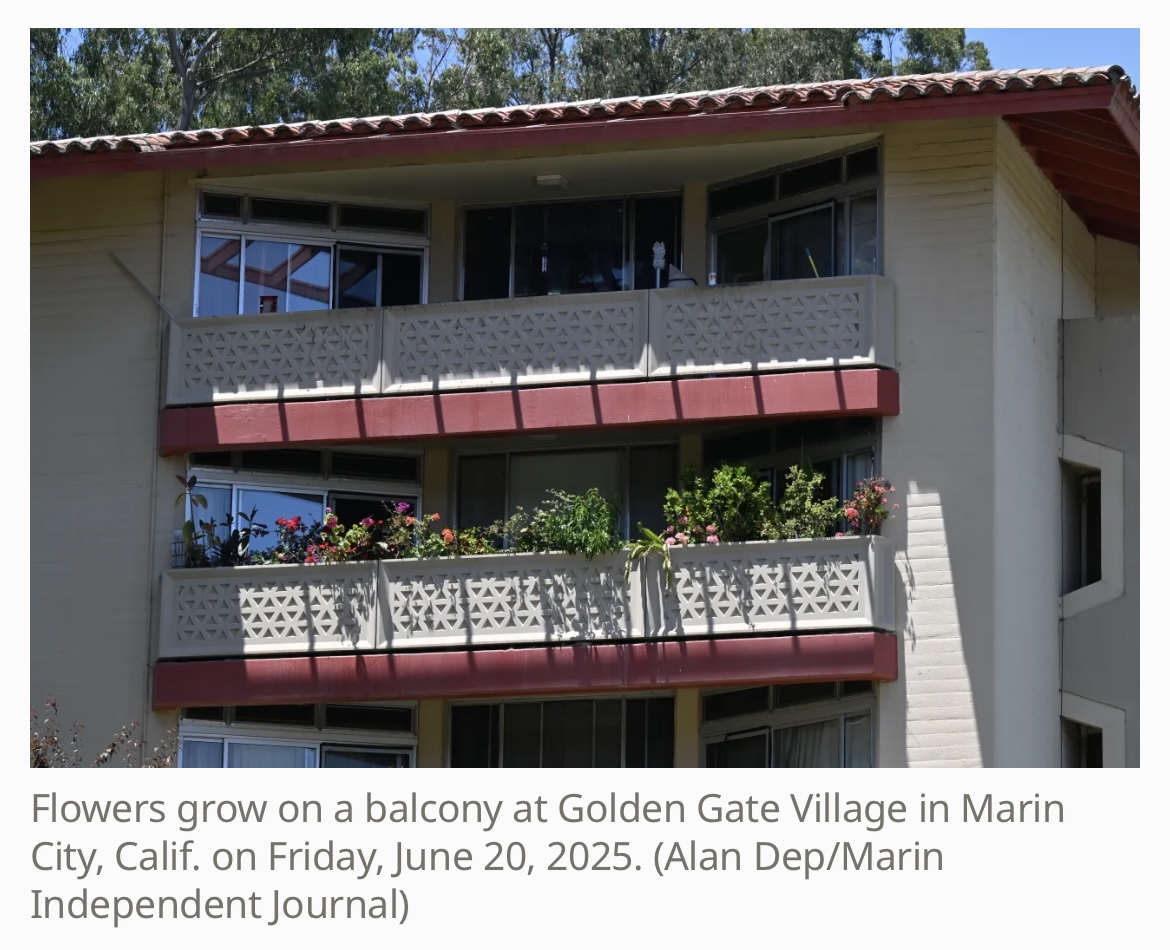
This next article, also from the Marin IJ reports that the greatly past due necessary work to renovate Golden Gate Village is likely to start at the beginning of next year. This is very good news for the residents, who have lived in less than acceptable conditions for so many years, that it seemed like the day would never come. Many residents will only believe it when they see it start, having been promised for decades that improvements would be made to their living conditions. This report gives those same rightly skeptical residents some hope that this time it just might happen in their lifetimes.
Marin City public housing renovation could begin in February 2026

The effort to rehabilitate the Golden Gate Village public housing complex in Marin City is moving forward despite a Trump administration proposal to cut funding for rental assistance programs.
The Marin Housing Authority board voted unanimously Tuesday to enter into a master development agreement with Burbank Housing Development Corp. to oversee the project.
“We’ve never been closer to having this project happen,” said Supervisor Dennis Rodoni, who serves on the board along with the other four supervisors.
In a report to the board, Kimberly Carroll, executive director of the Marin Housing Authority, wrote that the Trump administration has proposed “a historic 44% cut — nearly $26.7 billion” in rental assistance programs at the U.S. Department of Housing and Urban Development.
She said the cuts would affect housing choice vouchers that support more than 4.4 million households across the country, including 3,200 in Marin. Carroll also said the Trump administration wants to eliminate dedicated federal funding for public housing capital and operating funds.
“This would mean no new federal support to maintain or repair public housing stock,” Carroll wrote, “putting at risk operational funds for our six properties, including five serving older and disabled adults and Golden Gate Village, which serves families, children and seniors.”
However, Mike Andrews, an expert the federal housing department hired to advise the Marin Housing Authority, said there is “a little bit of a silver lining in the budget clouds.” He said the administration appears supportive of the two programs that are vital for completion of the Golden Gate Village renovation.
One is the low-income housing tax credit program, which was initiated by the Tax Reform Act of 1986 under President Ronald Reagan. The program permits tax credits to be issued for the acquisition, rehabilitation or construction of rental housing for lower-income households.
The Marin City project budget anticipates that more than $100 million of about $266 million in project expenses will be covered by revenue from the sale of the tax credits.
The renovation project also depends on the issuance of “tenant protection vouchers.” Andrews said that while the administration is proposing cuts to other types of federal housing vouchers, “that account has seen an uptick.”
There is a competitive process to receive the tax credits from the state, and the Marin Housing Authority submitted its application in April. Andrews said the application scored highly, suggesting it will succeed. The California Tax Credit Allocation Committee, which administers federal and state low-income housing tax credit programs, will notify the Marin agency on Aug. 20 if it will receive the credits.
Once that reservation letter is signed, the project would have 180 days to begin construction,” Andrews said. “That puts the construction date at Feb. 16, 2026.”
Andrews said that is why it is important to move forward now with the master development agreement with Burbank.
“There is a lot of work to be done to get to a point where the project would be ready to start construction,” he said.
Members of the Golden Gate Village resident council expressed deep concern about the use of the word “demolition” in the tax credit application.
“The report says demolished to the slab and the frame,” Beverly Freeman said. “That means the historical integrity of the building will be destroyed.”
“I’m kind of left with a feeling that the powers-that-be’s knee is on the neck of Golden Gate Village,” Freeman said. “Kind of imagine George Floyd.”
Royce McLemore said, “I refuse this report in the mighty name of Jesus.”
Andrews said there was no reason for alarm. He said the language simply indicates that much of the interior of the buildings would be replaced during the renovation.
“A lot of the old windows, doors, cabinets, bathtubs, toilets, sinks and the electrical systems will all be pulled out of the building and disposed of, and new will be installed,” Andrews said. “That’s what was meant by the term demolition that was used in the application.”
He added that because the complex has been listed on the National Register of Historic Places, a preservation architect will be hired to help design the project to ensure its historical integrity is maintained.
Golden Gate Village had lacked a resident council since December, when the former council disbanded because of internal strife. A new resident council was seated on Monday. There was no election because only four people applied for five seats: McLemore, who served on the previous council, and Jae Moses, Natalie Broomfield and Sheila Robson. Those four then selected Freeman to fill the fifth seat.
Carroll said the Marin Housing Authority “will need to work with this new resident council to draft a memorandum of understanding between the council and MHA.”

Marin City marks Juneteenth with ceremony and celebration
By STEVEN ROSENFELD | srosenfeld@marinij.com
UPDATED: June 21, 2025 at 5:07 PM PDT
Marin City honored its Black ancestors, heritage and history in its ninth Juneteenth ceremony and festival on Saturday.

Organizers planned an altar of flowers and family photographs at the Rocky Graham Park amphitheater and a ceremony with prayers and offerings in English, Spanish and the traditional language of Garifuna. The plan also included a chorus leading the Black national anthem, “Lift Every Voice and Sing,” and a mix of spirituals, southern gospel and secular songs that traced an arc from bondage to hope and freedom.
The agenda also included a ceremony acknowledging Marin City’s youngest and oldest residents and crowning a community king and queen. In the afternoon, live music and a creativity-themed fair were planned with three dozen booths presenting a range of arts, crafts, fashion, jewelry, books and food.
“Juneteenth is a Texas holiday, but we still celebrate the essence of it,” said Oshalla Marcus, Marin City Arts and Culture director and festival curator. “It took Juneteenth to have a celebrating or acknowledging the end of over 250 years of legalized enslavement of human beings and sex trafficking.”

On June 19, 1865, the Union Army freed the last enslaved Black people in Galveston, Texas, marking institutional slavery’s demise. The anniversary of the day became a federal holiday in 2021.
While not as well known as the Emancipation Proclamation that declared all slaves free on Jan. 1, 1863 during the Civil War, the anniversary has become an occasion to reflect on the African American struggle for freedom, rights and dignity.
“Everyone has their own holiday,” said Darnell Uutrey, the event’s master of ceremonies. “And our history, as much as it’s so engrained in so much of America itself, it’s basically been washed over.”
“I talk with a lot of kids and people don’t necessarily even understand what Juneteenth is half the time,” he said. “I find myself having to explain that, well, we’ve been here, we were told that we were slaves, but our whole history is not based on us being slaves.”

Carol Thomas, who is leading the ceremony’s choir of seven singers who planned to open with “Go Down Moses,” said the songs she selected emphasized narratives of struggle, hope and faith that are relevant in the present.
“I want it to be more of an experience than just people saying, ‘Oh, I like that song,’ but remember the story that is being told through music,” she said. “Look at what’s happening in our nation, what’s happening in the hearts and minds of people.”
Thomas, a retired county mental health worker, referred to the Trump administration’s efforts to cut needed services for vulnerable people and its opposition to DEI, or “diversity, equity and inclusion,” in government hiring, programs, education and political discussions.

“Now, more than ever, people need to have something to hold onto that’s bigger than themselves,” she said. “We’re dealing with trauma. We’re dealing with grief. Not just in a natural sense from death and destruction, but grieving over the loss of service, the loss of community, grieving over the loss of our nation, what it is coming to and what that looks like for generations to come.”
“We’ve been celebrating Juneteenth long before it was a federal holiday and doing many powerful things in the country before DEI,” Marcus said. “It’s important that we continue to create institutions and continue our actions in spite of what the American government does.”
Like Juneteenth, Marin City’s history has roots in Texas. Many of its earlier residents came from Texas and Louisiana to escape racism and work in Sausalito’s integrated shipyards in the early days of World War II.

Homer Hall moved to Marin City in 1953 after his uncles urged his mother and her sister to leave Monroe, Louisiana. “That’s where I’m from. I was born in a sharecropper’s house, not in a hospital,” said the Air Force veteran, home contractor and Marin Housing Authority board member. “At the time, the Black people that came here were only going to be here for the war effort. So when the war was over and they closed the shipyard, they didn’t have anywhere to go. The only option they had was to go back to the South.”
“The reason there are a lot of black people in Marin City is simply because Marin City was preserved by this White lady, Vera Schultz, who was a supervisor,” he said, saying she kept the tract from from being privately developed. In the late 1950s, associates of the architect Frank Lloyd Wright built Golden Gate Village, which is Marin’s largest public housing project.
“We were one of the first 10 families to move in,” Hall said.
Like much of America, Marin County has had its own version of segregation for many years, Hall said, even if that has been slowly changing.

“I know, my growing up here, that very few White people have very few Black friends, especially if you live in Marin City,” he said. “A lot of White people really didn’t get dialed in until George Floyd.”
The 2020 police murder of Floyd led to Black Lives Matter signs appearing on lawns and windows across the county. Despite Trump administration efforts, Marin’s local governments support DEI initiatives and many are holding Juneteenth activities.
Change can happen, as the spiritual and gospel songs at the Juneteenth ceremony noted and Marin City honored its wider significance.

It is even more important for us to be celebrating this now and making sure that it doesn’t get commercialized,” said Marcus. “And what it means for this country that is so divided.”
Originally Published: June 21, 2025 at 4:54 PM PDT
MARIN VOICE
What is best for Tam’s Black students?
By Jennifer Silva

Like many parents, I moved to Marin for our excellent public schools — the No. 1 educational outcomes in the state. But these schools aren’t excellent for all. We have high disparities by race.
When my oldest entered high school in 2017, I learned about Tam High’s long history of anti-Black racist incidents. His entry to high school started with a spray-painted racist slur, and more followed. In response, the district implemented a Racial Equity Board Policy, Racial Equity Task Force and an Anti-Racist Strategic Plan.
Yet, the incidents continued. A video of White students laughing as they repeated a racial slur. Separately, a photo of a student’s face emblazoned with a slur and swastika was shared. The football team was put on probation after two racist incidents. It is both common sense and empirically proven that these types of racist incidents lead to alienation, trauma and educational disparities for Black students. The district has been trying to address these inequities. For years, little progress was made.
This year has been different. Tam High launched the Black Student Support Team and hired Tenisha Tate-Austin and Paul Austin to lead the program. These highly qualified and trusted consultants were the logical choice. Tate-Austin is a seasoned educator and former Tam High vice principal experienced in addressing racial equity issues. Austin founded Play Marin and is an esteemed youth leader and mentor. They were often the first people the district called after racist incidents to provide support for students.

This first year of the BSST produced outstanding results. F grades for Black students decreased by 50%, Black attendance increased and 87% of Black students surveyed reported a greater sense of belonging at school. Many Tam teachers support the program. Many Black students report that they finally feel like they belong at Tam. It was stated in a recent board meeting that only Tam High has shown this great improvement in outcomes. The BSST is working.
Despite these results, the Tamalpais Union High School District Board of Trustees voted 3 to 2 not to renew the contracts for Tate-Austin and Austin. This vote was against the recommendation of Superintendent Tara Tapier, a large number of teachers, staff and many parents and students. Over 1,200 signed a petition disputing this decision, 100 Tam faculty and staff sent a letter to the board in support of continuing the contracts. The three board members opposing the contracts are Jenny Holden, Cynthia Roenisch and Kevin Saavedra.

The trustees say the district can’t afford this expense, that there were irregularities in the contracts and that the program could be run by internal staff. I don’t believe that stands up to scrutiny.
The district had already accounted for the expense in the budget. There is no requirement for further cuts this year. Staff responsible for these duties testified to the board that they did not have the skills or relationships to achieve the results Tate-Austin and Austin did.
Bringing new staff in house is not a plausible solution for next year. Summer is starting, we have a new superintendent and the high cost of living makes it very difficult for TUHSD to recruit new staff. I find it inexplicable that trustees picked these one-year contracts, representing less than 0.2% of the school budget, for extra scrutiny. The district spends $20 million on special education. Why is $250,000 for Black students unaffordable?

More importantly, the trustees’ concerns ignore the board’s No. 1 responsibility — our students. It is the duty of every trustee to “keep learning and achievement for all students as the primary focus.” The uncontroverted evidence before the board — including district recommendations, community testimony and perfor mance metrics — showed the program to be uniquely effective for Tam’s Black students. Addressing the needs of this uniquely disadvantaged population has been declared a district priority.
This decision was a mistake, but it can be fixed.The next TUHSD board meeting is Tuesday. I implore the board to add these contracts to the agenda and bring Tate-Austin and Austin back for the 2025-2026 school year.
Jennifer Silva, of Sausalito, is a former member of the PTSA boards at Tamalpais and Redwood high schools in the Tamalpais Union High School District.
$250,000 is a lot of money, just like board member Jenny Holden stated in the meeting to announce their decision to not reinstate the contracts of Paul Austin and Tenisha Tate-Austin last month. It's understandable that the TUHSD Board of Trustees would be concerned about spending that much money on any program at one of the five high schools in Marin. It's the board's responsibility to be wise about the district's spending. The reality is that not all good programs can be funded, regardless of how successful they are.
So, when the board's biggest concern for continuing a program is it's funding and a community group agrees to cover the cost of that program, it seems logical that everybody would be happy with the outcome. There was a problem and it got solved. The board should be happy because they didn't have to spend $250,000 to continue a popular and successful program. The community should be happy because a program they consider valuable to the students will continue.
How then, could the board reject the funds necessary to continue the program? It makes no sense and can only lead to speculation and accusations for why.
Tam Union school district rejects private funds for 2 consultants
By KERI BRENNER | kbrenner@marinij.com | Marin Independent Journal
UPDATED: June 25, 2025 at 3:59 PM PDT
The Tamalpais Union High School District has turned down an offer of $250,000 in private funding for two consultants to help Black students at Tamalpais High School.
The Friends of Tam District, a community group, sought to pay for a one-year contract renewal for Tenisha Tate-Austin and Paul Austin. They oversee the Black Students Success Team and the Tam Hub drop-in center at the school.
But the district declined to place the item on the agenda for the board meeting on Tuesday, and trustees did not discuss or respond to any of the sometimes caustic public comments at the meeting.
“Cutting the contracts of Tenisha and Paul, who created the BSST and the Tam Hub, does more harm to Black students, and the broader school community, than it helps,” said parent Vanessa Justice, one of about 20 speakers at the crowded meeting with more than 65 attendees. “The community outrage speaks for itself.”
Cynthia Roenisch, the president of the board, said before the meeting that the matter has already been decided not to renew the contracts. Instead, she said, school staff will maintain support for Black students.
The incoming district superintendent, Courtney Goode, who starts the job next week, has already begun plans that will put employees in charge of the Black Student Success Team and Tam Hub programs, Roenisch said.
“The board steadfastly supports Dr. Goode in his efforts, including using his own experience and expertise in establishing support systems for students,” Roenisch said. “The board looks forward to learning more specifics of the support services at the Aug. 12 board meeting.”
The district has faced public pressure since June 3, when the trustees voted 3-2 not to renew the contracts for Austin and Tate-Austin. Their programs offer academic support, mentoring and tutoring.
Cristine DeBerry, a leader of the Friends of Tam District, said she and others were baffled by the trustees’ rejection of the private funding.
“I am confused how we have gotten to this place of such hostility and disrespect for parents, teachers and children for simply asking for the opportunity for our children to succeed in their high school,” DeBerry told the board on Tuesday.
“You have done serious damage with the way you have treated us and our children,” she said. “You have caused real harm to my family and to other families in this room.”
DeBerry’s online petition to restore the two contracts had nearly 1,600 signatures as of Wednesday.
Parent Gabrielle Muse told trustees the controversy was the result of “systemic racism in action.”
“You didn’t prioritize our comments; you refer to the talented educators not by name, but as ‘a couple’; and you’ve used every excuse in the book, all of which have been thoroughly and effectively debunked by my fellow colleagues and educators,” Muse said.
Muse said trustees have been “lying to this community” because the board had “no plan for seven years” that worked to help Black students before Austin and Tate-Austin arrived. She said the excuse that the contracts were “rushed” was a lie. “How could it be rushed?” she said. “You had seven years.”
Another unsupported rationale by the board, according to Muse, is a lack of money in the budget to cover the contracts. The private funding would have solved the problem, she said.
“It is not the budget — it is racism, plain and simple,” she said.
Roenisch, who had to call for order several times during the public comment period, said Goode met with students, parents, Tam High staff and the consultants as he gathered information on the program during a recent visit.
“He reiterated very clearly that Mr. Austin and Ms. Tate-Austin were not returning to Tamalpais High School, and communicated this directly to Mr. Austin and Ms. Tate-Austin,” Roenisch said.
DeBerry was skeptical that the new structure will have the same positive results that consultants achieved.
“Despite the measurable improvements BSST has generated in just one year — including stronger academic performance, increased student engagement and a greater sense of belonging — the board has chosen to terminate the program rather than provide a pathway to sustain it,” DeBerry said.
Austin said he holds onto the belief that the matter will be resolved somehow in a positive way.
“I’m always hopeful — I believe in humanity,” Austin said. “I expect for people to do what’s right. That’s how I live my life. Whether they do that or not, they have to live with that. I’m just nervous that it’s going to hinder our kids even more.”
Originally Published: June 25, 2025 at 3:55 PM PDT
July 4th History of the Marin County Fair
https://mailchi.mp/aa6fc3bf7b13/test-newsletter-email-12700406?e=db6ae6c9b9
July 10th Marin City playgrounds grand opening.

July 12th Come to the Table Food Equity: Why More Than Enough is Not Enough

Leah’s Rothstein’s post on Come to the Table